Pathways & Journeys
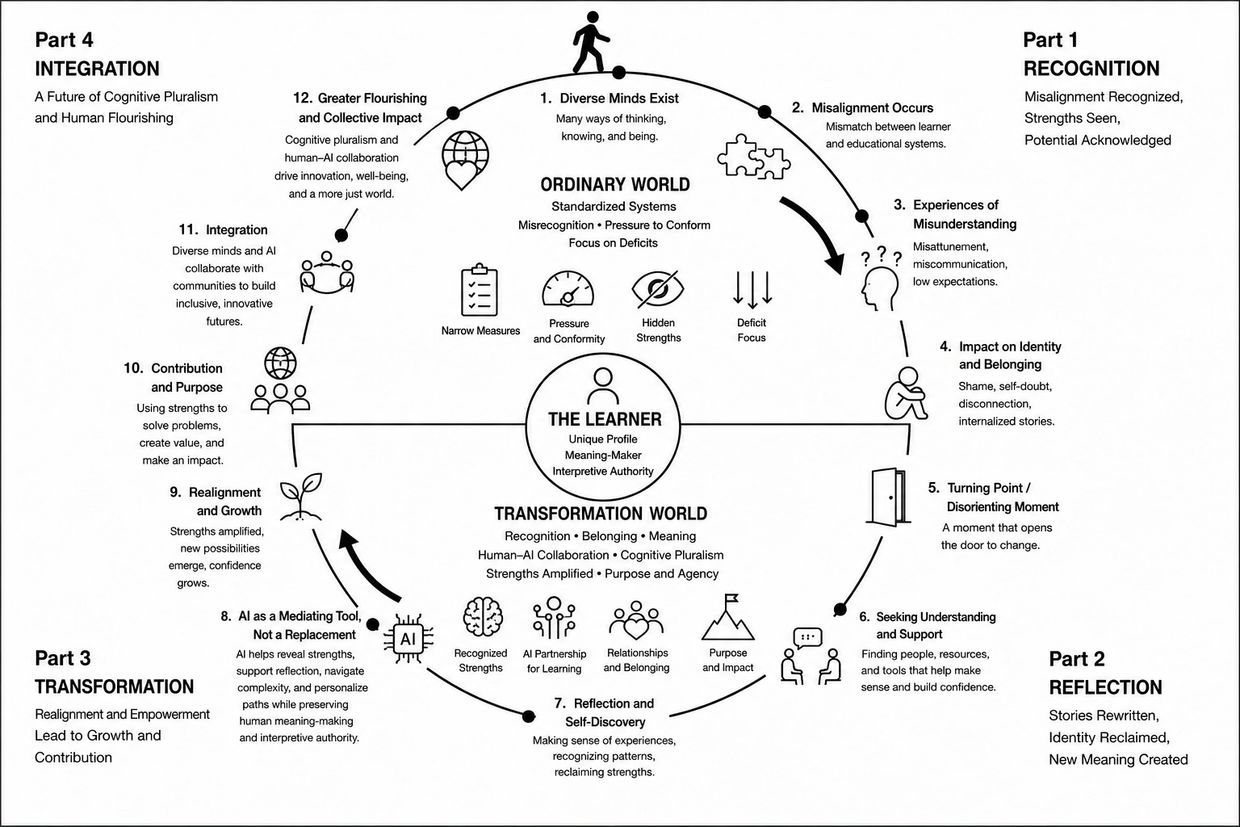
The dissertation argues that society is entering a profound transformation. Artificial intelligence, rapid technological change, and increasingly complex global challenges require people who can think creatively, see patterns, connect ideas across disciplines, navigate uncertainty, and work collaboratively with both humans and intelligent technologies. Yet many educational systems were designed for a different era—one that valued standardization, predictability, conformity, and uniform measures of achievement.
As a result, there is a growing mismatch between what the future requires and what schools reward.
What if many students who struggle in school are not failing because they lack ability, but because schools fail to recognize the kind of intelligence they possess?

The study introduces the concept of spikey minds—people whose abilities are uneven rather than uniform. These individuals often possess exceptional strengths in areas such as:
At the same time, they may experience challenges with:
Traditional educational systems frequently focus on the areas of difficulty while overlooking the extraordinary strengths. What appears as inconsistency may actually be a highly specialized cognitive profile that excels under the right conditions.
The dissertation suggests that many innovators throughout history—from Temple Grandin to leaders in technology and science—demonstrated characteristics associated with these uneven cognitive profiles. Their success often emerged not because they fit educational norms, but because they eventually found environments that valued their unique ways of thinking.
One of the dissertation's central arguments is that educational challenges are often misunderstood. Rather than viewing students as deficient, the study proposes that difficulties frequently arise from misalignmentbetween a learner's way of thinking and the expectations of educational institutions.
The problem may not be:
"What's wrong with the student?"
but rather:
"How well does the educational environment recognize and support different ways of knowing, learning, and contributing?"
This perspective is influenced by the concept of the Double Empathy Problem, which suggests that misunderstandings occur not because one person is deficient, but because people with different experiences and cognitive styles struggle to understand one another. In schools, these misunderstandings often become one-sided because institutions hold more power than students. As a result, learners are frequently expected to adapt while systems remain unchanged. Over time, repeated experiences of being misunderstood can shape identity. Students may begin to believe negative stories about themselves, internalizing messages that they are lazy, incapable, or not intelligent, even when they possess remarkable strengths.
The dissertation expands the idea of diversity beyond traditional discussions of race, culture, or disability. It argues for cognitive pluralism—the recognition that there are many legitimate ways of thinking, learning, and understanding the world.
This includes:
The study suggests that schools often privilege a narrow version of intelligence while overlooking valuable forms of knowledge that do not fit conventional expectations.
In a world facing climate change, technological disruption, social polarization, and global complexity, society increasingly needs people who can think differently—not merely people who think the same way more efficiently.
The dissertation argues that many of the cognitive traits often viewed as weaknesses in traditional educational settings are the very traits that have driven major innovations throughout history. It points to publicly documented examples such as Bill Gates, Steve Jobs, Jeff Bezos, and Temple Grandin—not as diagnostic case studies, but as illustrations of how unconventional ways of thinking can become extraordinary assets when supported by the right environment. Bill Gates demonstrated intense technical immersion, deep pattern recognition, and an unconventional pathway to learning that helped shape the personal computing revolution. Steve Jobs became known for nonlinear thinking, systems-level design, creativity, and an ability to connect ideas across disciplines in ways others often overlooked. Jeff Bezos built Amazon through long-term strategic thinking, relentless experimentation, and a willingness to navigate uncertainty that many organizations would have considered risky. Temple Grandin transformed livestock systems and public understanding of autism through highly visual thinking and extraordinary attention to detail.
What these individuals share is not a common diagnosis or personality type. Rather, they illustrate a broader principle: traits that create friction within standardized systems can become powerful sources of innovation when circumstances allow those strengths to emerge. Characteristics such as intense focus, unconventional problem-solving, pattern recognition, systems thinking, and tolerance for ambiguity may appear disruptive in traditional classrooms, yet they are increasingly valuable in a world defined by complexity and rapid change. The dissertation argues that society often celebrates these qualities only after success becomes visible. Before recognition occurs, however, many individuals with similar cognitive profiles experience misunderstanding, misrecognition, or pressure to conform.
The central question, therefore, is not how many exceptional innovators exist, but how many potential innovators are overlooked because educational systems are designed to reward uniformity rather than cognitive diversity.
In this context, the concept of Spikey Minds is not simply about supporting students who struggle. It is about recognizing that future breakthroughs may come from learners whose strengths are currently hidden behind educational measures that fail to capture the full range of human intelligence.
One of the most forward-looking aspects of the dissertation is its treatment of artificial intelligence. Rather than viewing AI as a threat to human intelligence, the study presents AI as a potential partner in human learning and development. The key question is not whether AI will replace humans, but how humans and AI can work together in ways that strengthen human potential.The dissertation introduces the concept of hybrid intelligence, where human and artificial intelligence complement one another.
According to this framework:
The study repeatedly emphasizes that AI cannot replace the uniquely human processes of reflection, interpretation, identity formation, and purpose development. Those remain fundamentally human responsibilities.
Instead, AI can serve as a mediating tool.
It can help learners:
Importantly, the dissertation argues that AI should not become the authority that determines human worth or intelligence.
Rather, AI's most valuable role is supporting human recognition and reflection while preserving human interpretive authority.
In this vision:
AI helps people see more clearly—but humans decide what those insights mean.
The technology becomes a mirror, translator, and amplifier rather than a replacement for judgment, wisdom, or human agency.
Educational Transformation in the Age of AI
The study builds on the work of educational pioneer Seymour Papert, who argued decades ago that computers should be tools for thinking rather than machines that simply deliver instruction.
The dissertation suggests that AI offers a similar opportunity today.
Educational systems could use AI to:
However, these benefits are not automatic.
If implemented poorly, AI could reinforce standardization by encouraging greater surveillance, automation, and conformity. If implemented thoughtfully, AI could help schools become more responsive to diverse learners and ways of knowing.
The difference lies in whether AI is used to make people fit the system or to help systems better understand people.
The dissertation examines the experiences of adults who identify with spikey cognitive profiles and asks them to reflect on their educational journeys. Through their stories, the research explores:
Their narratives become a window into how educational systems influence belonging, purpose, confidence, and self-understanding.
Ultimately, Spikey Minds is not simply a study about neurodiversity, education, or artificial intelligence. It is a broader argument about human potential.The dissertation suggests that the greatest challenge of the twenty-first century is not creating more intelligence through technology. Rather, it is learning to recognize, value, and integrate the diverse forms of intelligence that already exist within humanity.
In this vision:
The dissertation concludes that future-ready education will not emerge from producing more uniform learners. It will emerge from creating systems capable of recognizing and cultivating the extraordinary variety of human minds already present among us.
The future, it argues, belongs not to a single model of intelligence, but to the thoughtful integration of many forms of intelligence working together—human and artificial, individual and collective, cognitive and cultural.

“Ideas cause ideas and help evolve new ideas.
They interact with each other and with other mental forces in the same brain,
in neighboring brains, and thanks to global communication,
in far distant, foreign brains”.
(Neuropsychologist Roger Sperry)
“Why, sometimes I’ve believed as many as six impossible things before breakfast.” —Lewis Carroll